Developmental Progress Report
Objective results at intake and every reassessment.
The Developmental Progress Report shows how a child’s EarliPoint results compare with peers, and how those results change from one assessment to the next. Now available to EarliPoint customers.
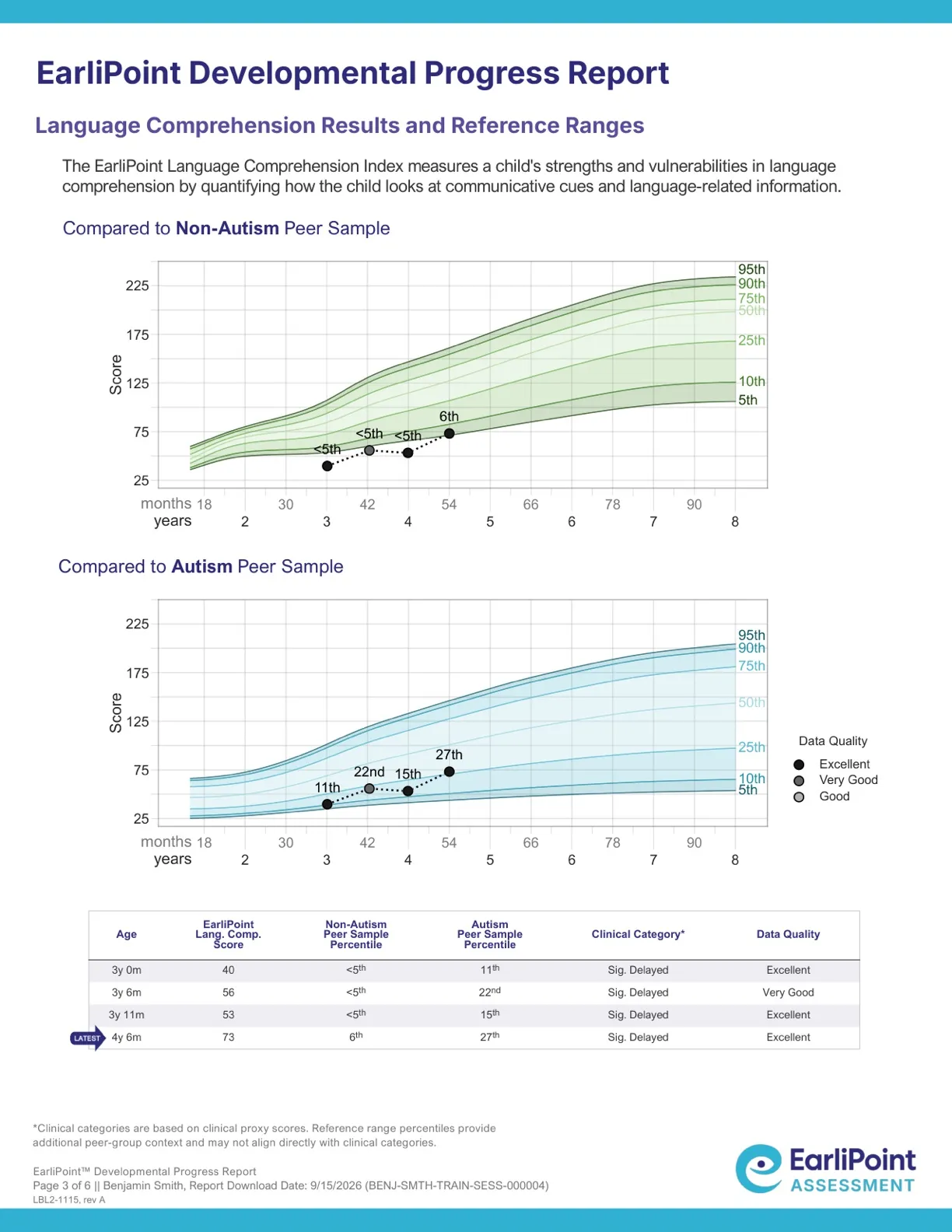
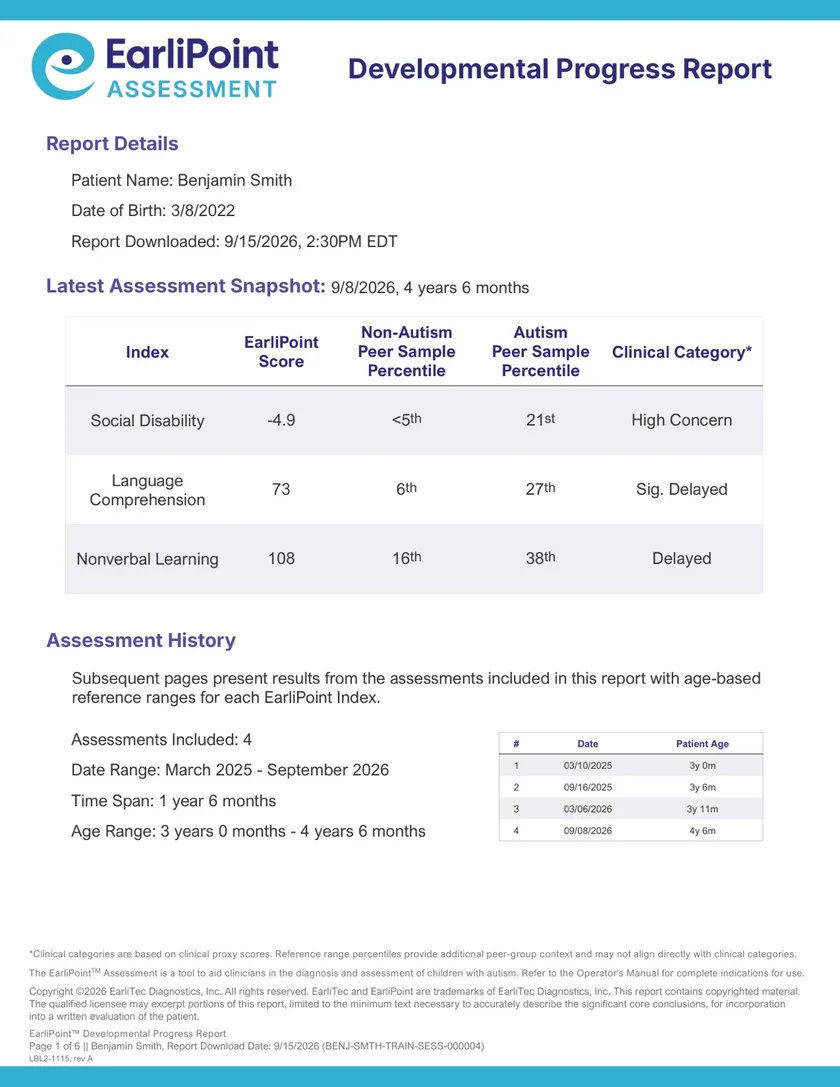
Sample report. Not patient data.
How it works
From one session to a progress report
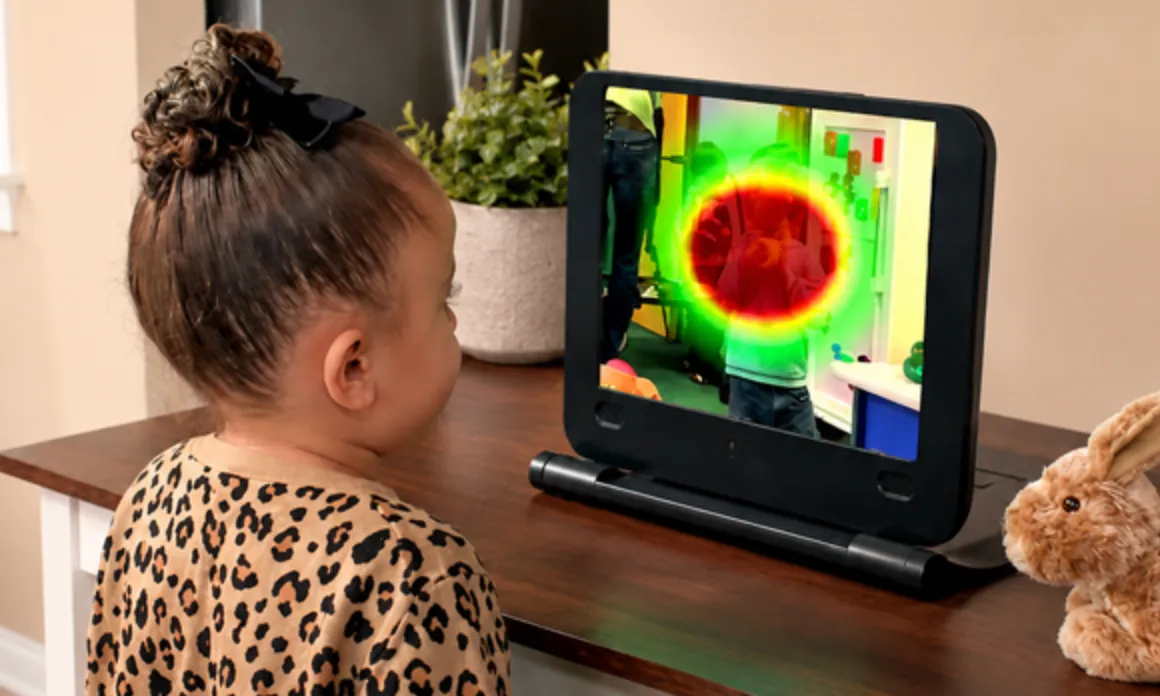


Where children without autism look at this moment
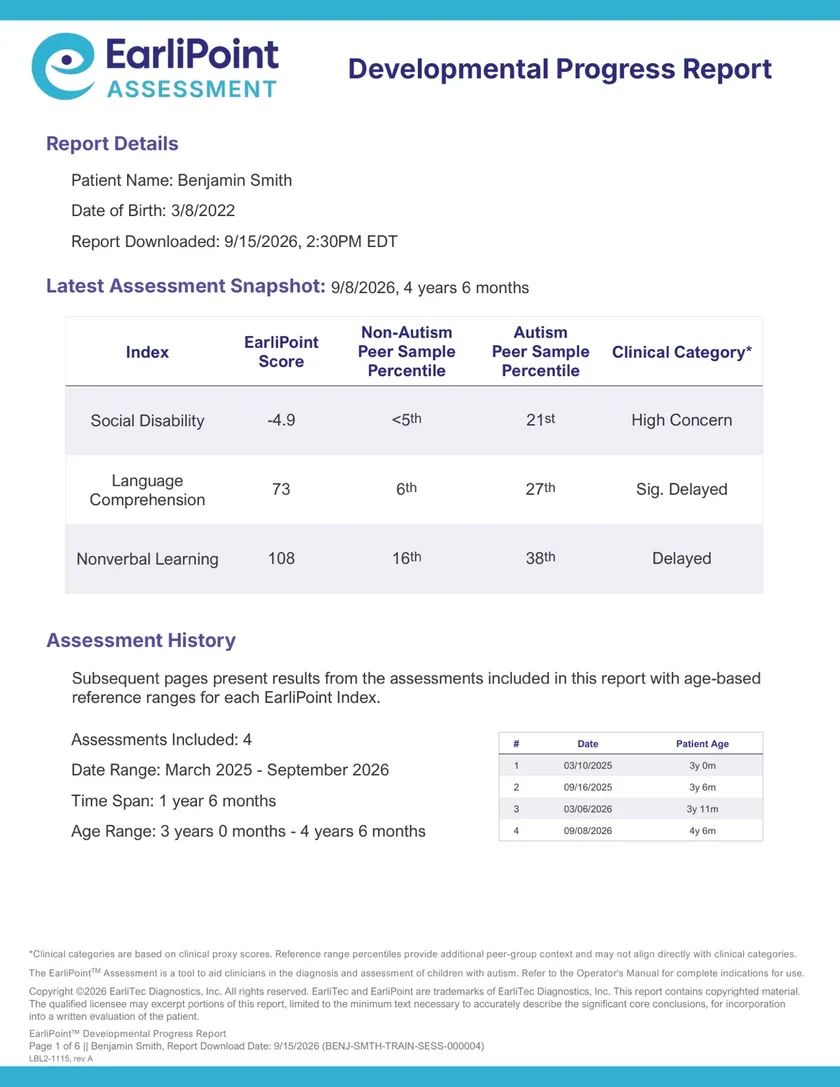
Latest assessment snapshot
| Index | Score | Non-Autism percentile | Autism percentile | Clinical category |
|---|---|---|---|---|
| Social Disability | −4.9 | <5th | 21st | High Concern |
| Language Comprehension | 73 | 6th | 27th | Sig. Delayed |
| Nonverbal Learning | 108 | 16th | 38th | Delayed |
Plus a data quality rating for every session: Excellent, Very Good, or Good.
- FamilyResults explained by their clinician
- Care teamGoals for the next period of care
- PayerProgress, at reauthorization
4 assessments · 1 year 6 months
- BaselineBaselineMar 2025Age 3y 0m
- ReauthorizationReauth.Sep 2025Age 3y 6m
- ReauthorizationReauth.Mar 2026Age 3y 11m
- ReauthorizationReauth.Sep 2026Age 4y 6m
Same session, same measurement, every time.
Sample report data. Not patient data.
01 The session
A child watches short videos
The child sits in front of the device and watches short videos of children playing and interacting. A trained staff member runs the session. Nothing is asked of the child beyond watching.
02 What is measured
Where the child looks, moment to moment
Eye-tracking sensors capture more than 120 data points per second while the child watches. Each moment is compared with clinically validated reference data from more than 3,600 assessments.
03 What comes out
Three EarliPoint indices
Results are reported on three indices: Social Disability, Language Comprehension, and Nonverbal Learning. Each comes with a score, peer-sample percentiles, a clinical category, and a data quality rating for the session.
04 Who gets it
A qualified clinician reads it first
Results go to a qualified clinician, who interprets them alongside their own observation, session data, and the tools they already use. From there the report supports the conversations that follow: with the family, the care team, and payers at reauthorization.
05 Next time
The same assessment at every reassessment
Run it at intake to set a baseline, then again ahead of each reauthorization, typically every six months. The child is measured the same way every time, so each result can be read alongside the ones before it.
06 The Developmental Progress Report
Two peer samples, one child
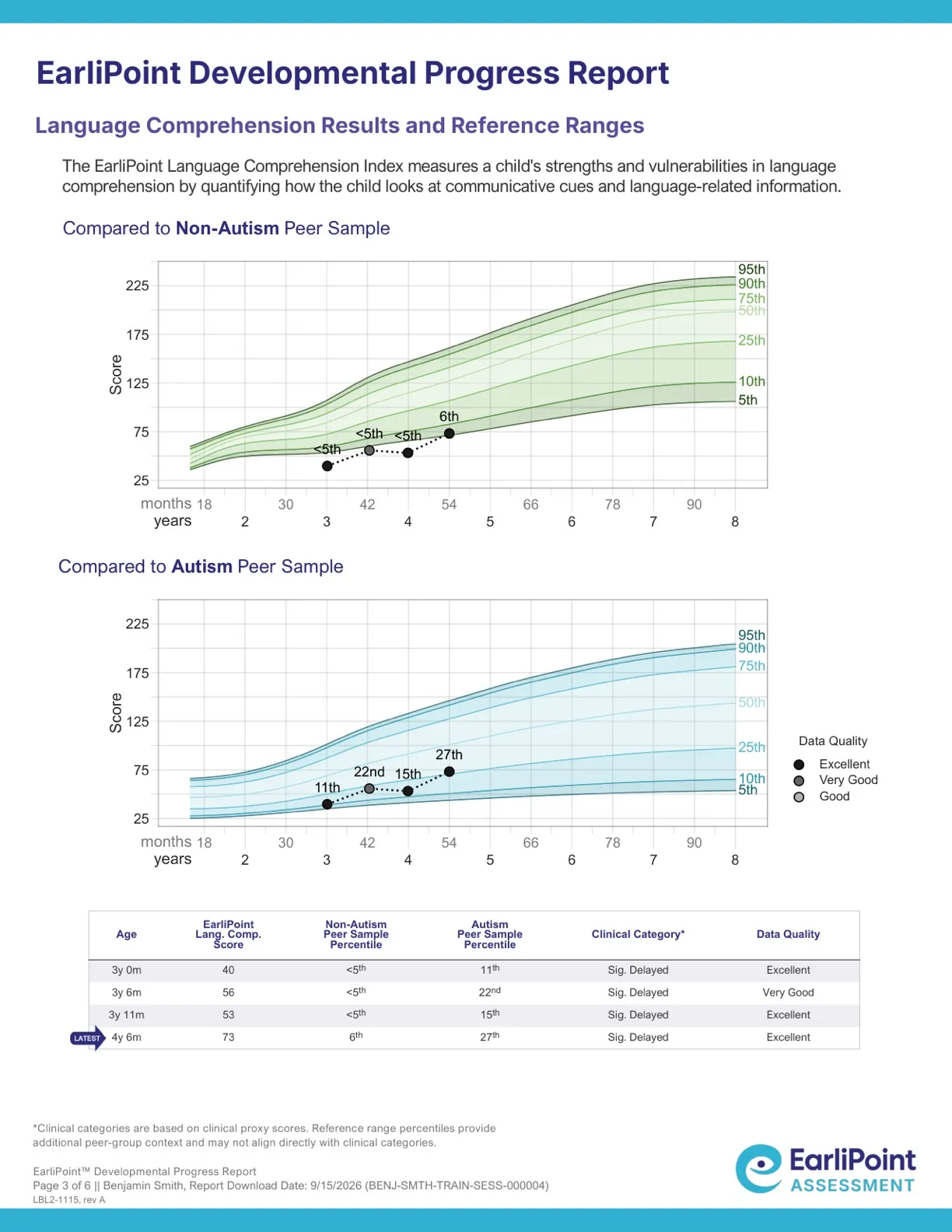
The report places every assessment against age-based reference ranges for a Non-Autism Peer Sample and an Autism Peer Sample. In this sample report, Language Comprehension stays at or below the 6th percentile against non-autism peers, while the same results move from the 11th to the 27th percentile against autism peers.
Sample report. Not patient data.
Inside the report
What the report contains
Latest assessment snapshot
Score, percentile against each peer sample, and clinical category for all three indices.
Assessment history
Every assessment included, with dates, the child’s age at each, and the time span covered.
Reference ranges for each index
Social Disability, Language Comprehension, and Nonverbal Learning, each charted against both peer samples by age.
Data quality for every session
Each assessment is rated Excellent, Very Good, or Good, so results can be read with that in mind.
Looking behavior, visualized
For the latest assessment, where the child looked compared with non-autism looking behavior, linked to skills like joint attention and requesting.
What each index means
A closing page explains each index and who is in each peer sample, written for clinicians and the people they share results with.
Common questions
What is the Developmental Progress Report?
A report that shows how a child’s EarliPoint results compare with peers and how those results change from one assessment to the next. It covers the three EarliPoint indices, Social Disability, Language Comprehension, and Nonverbal Learning, each against a Non-Autism Peer Sample and an Autism Peer Sample.
Is the Developmental Progress Report a diagnosis?
No. The DPR is a non-diagnostic report. Qualified clinicians interpret it alongside their own observation and the other information they use. Clinical categories are based on clinical proxy scores; reference range percentiles add peer-group context and may not align directly with clinical categories.
How many assessments does it need?
One. A single assessment establishes a baseline. With two or more, the report shows results across assessments over time.
How often should a child be reassessed?
Most ABA providers assess at intake and again ahead of each reauthorization, typically every six months. The timing is the clinician’s call.
Who is in each peer sample?
Reference ranges come from more than 3,600 clinically validated EarliPoint assessments. For Social Disability, the Non-Autism Peer Sample includes children without autism and some with non-autism developmental delays, and the Autism Peer Sample includes children with autism. For Language Comprehension and Nonverbal Learning, the Non-Autism Peer Sample includes children without autism or developmental delays, and the Autism Peer Sample includes children with autism or developmental delays.
Who receives the report?
The qualified clinician who ordered the assessment. Clinicians decide how results are shared with families, and they may excerpt the report’s core conclusions into a written evaluation.
Do current EarliPoint customers have it?
Yes. The Developmental Progress Report is available to EarliPoint customers as part of the latest platform release.
See a full sample report
Walk through a Developmental Progress Report page by page with our team, and talk through where it fits in your intake and reauthorization cycle.
- A sample report, section by section
- How the two peer samples read together
- Where it fits in your reassessment schedule
Request a walkthrough
Required fields are marked with an asterisk. Never share sensitive information (credit card numbers, Social Security numbers, passwords) through this form.