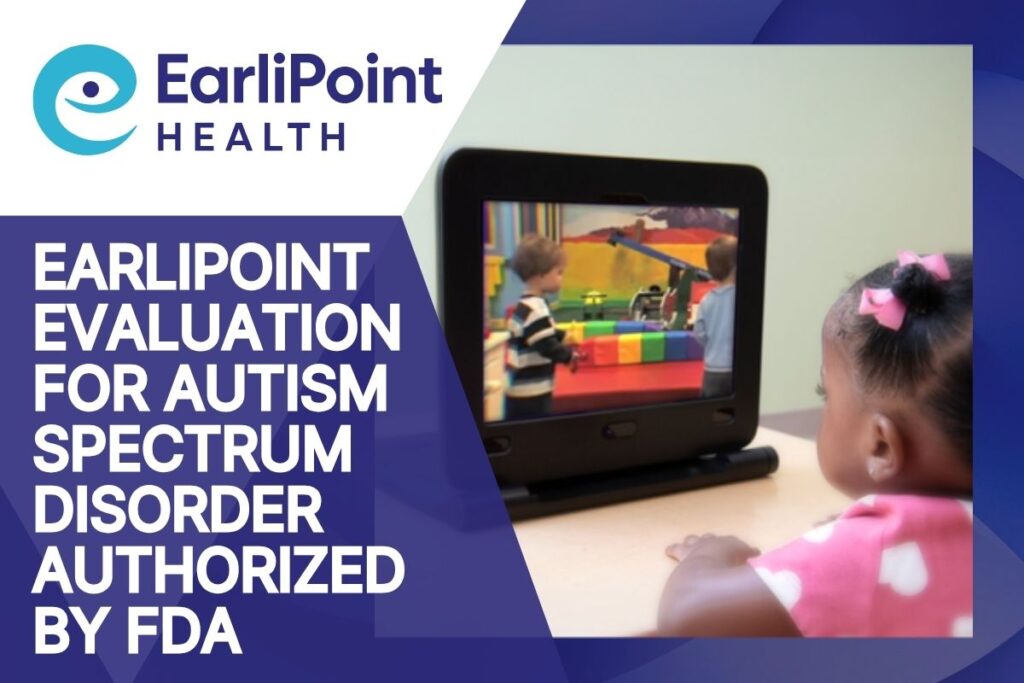
EarliPoint Evaluation, the first-of-its-kind FDA-authorized device, is a gamechanger for early diagnosis of Autism spectrum disorder.
Marcus Autism Center (marcus.org), a subsidiary of Children’s Healthcare of Atlanta (choa.org), recently announced an exciting new tool to help diagnose autism. EarliPoint Evaluation, the first biomarker-based, eye-tracking technology to help diagnose and assess autism in children between 16 and 30 months old, measures children’s looking behavior to provide clinicians with objective measurements of each child’s strengths and vulnerabilities.
According to recent studies published by The Journal of The American Medical Association (JAMA) and JAMA Network Open, these measurements predicted expert clinician assessments with a high degree of accuracy, resulting in faster diagnoses and—critical for patients—quicker intervention and development of individual treatment plans for newly-diagnosed children.
“This technology is a first-of- its-kind, biomarker-based tool developed and clinically validated to aid in the diagnosis of autism,” says Ami Klin, PhD, Director, Marcus Autism Center at Children’s Healthcare of Atlanta and Division Chief of Autism and Developmental Disabilities at Emory University School of Medicine. “The published studies show that objective, performance-based biomarkers of children’s looking behavior can help clinicians by reducing the time required for accurate autism diagnosis from multiple hours of clinician assessment to as little as 12 minutes of objective measurements.”
How does it work? Children watch 12 minutes of video as the tool collects data, allowing clinicians to compare moment-by-moment looking behavior and measure it against thousands of divergencies compared to typically developing peers. By aiding in early and accurate diagnosis, EarliPoint Evaluation has the potential to help clinicians approach autism treatment with more speed and efficiency than ever before.
“If diagnosed earlier, child and family support systems can also happen earlier,” says Warren Jones, PhD, lead author and Director of Research at Marcus Autism Center at Children’s Healthcare of Atlanta and Nien Distinguished Chair in Autism at Emory University School of Medicine.
“Currently, only one in four children with autism is identified before age three,” he continues. “Our hope is that this tool can help alleviate this enormous public health challenge with earlier diagnoses and treatment.”
According to him, children who once faced long wait times and multiple referrals before being diagnosed at age four or five may now have the potential for early diagnosis, even as early as three years old.
Dr. Kim explains that “testing results were highly consistent with expert clinical diagnoses and gold standard assessments of each child’s needs, which are critical data for developing personalized treatment plans to enable the greatest gains for children.”