Dr. Cheryl Tierney from EarliPoint Health and Rose Griffin from ABA Speech came together around this topic because we both see value in integrating developmental and behavior analytic perspectives when working with young children.
Rose Griffin is both a speech-language pathologist and a board-certified behavior analyst, and Dr. Cheryl T. is a developmental pediatrician and Chief Medical Officer at EarliPoint Health. Although our professional training is different, there is considerable overlap in the questions we ask about how children learn. Behavior analysts, speech-language pathologists, developmental specialists, special instructors, educators, and other interventionists often spend many hours each week helping young children acquire new skills. That amount of direct contact creates an important opportunity not only to teach, but also to observe how a child is accessing and using information from the people around them.
When a child is having difficulty acquiring a skill, the answer is not always to increase the number of teaching trials or simply find a more effective prompt. Sometimes it is useful to ask a more developmental question: What capacities ordinarily support the acquisition of this skill, and are some of those capacities still emerging?
This becomes particularly relevant between 2 and 4 years of age. Although that may sound like a relatively narrow age range, it encompasses substantial change in social communication, symbolic representation, language, play, and the ability to learn through interaction with other people. Developmental milestones should never be treated as rigid deadlines, but age matters when interpreting what we see. The expectations for a newly 2-year-old are quite different from those for a child approaching 4.[1,2]
Our goal in this piece is to offer interventionists a developmental lens for thinking about joint attention, gesture, imitation, and representational play. These are not isolated prerequisite skills that must be mastered in a particular sequence. They are interacting aspects of early development that can provide useful information about how a child is learning and what may be helpful to support next.
Joint Attention Is Not the Same as Eye Contact
Joint attention is sometimes discussed as though it were synonymous with eye contact. Developmentally, it is much broader.
Joint attention involves coordinating attention with another person around an object, event, or experience. The meaningful feature is not how long a child looks at another person’s eyes. It is whether the child recognizes that another person’s attention carries information and can use that information during an interaction.
A 2-year-old, for example, may notice an airplane overhead after a parent points toward it. The child may look toward the airplane and then back toward the parent. The same child may carry an interesting toy across the room simply to show it to someone. These are early forms of coordinated social attention.
By this age, most children are using more than the earliest gestures of waving and pointing, and their repertoire of nonverbal communication is beginning to expand.[1,3] Over the next year, we expect those interactions to become more frequent, spontaneous, and integrated with language. By approximately 3 years of age, the question increasingly becomes not only whether the child can follow another person’s attentional cue, but whether the child initiates shared experiences and incorporates another person’s reactions into an ongoing interaction.
Joint attention is clinically important because it creates opportunities for learning. Research in autistic children has demonstrated associations between joint attention and subsequent language development, and joint attention has been directly targeted in randomized intervention studies.[4,5] In one randomized trial, preschool-aged autistic children receiving interventions targeting joint attention or symbolic play improved in the skills specifically addressed by treatment.[4] Follow-up work from that cohort found relationships between gains in joint attention or play and later expressive language outcomes, although the effects varied according to children’s initial developmental profiles.[5]
For a treating professional, this suggests that the useful observation is not simply, “Does this child look at me?” A more informative question is, “Does information from another person change what this child notices, understands, or does?”
A child who follows a point only after repeated prompts presents a different developmental picture from a child who spontaneously follows another person’s attention. Similarly, a child who points exclusively to obtain a preferred item is using communication differently from a child who points toward a truck outside simply because they want someone else to see it too.
That distinction between requesting and sharing becomes increasingly informative throughout the third year of life.
Gesture Becomes More Complex Across This Period
Gesture provides another useful window into early social communication.
At around 2 years of age, many children are already using a range of gestures in addition to pointing and waving. They may nod their head, blow a kiss, raise their arms to be picked up, or combine a gesture with spoken language.[1,3] At this stage, many gestures remain closely tied to immediate actions, objects, and familiar routines.
As children move from 2 toward 3, the range and function of gestures often become more varied. This is why simply recording the number of gestures a child produces may tell us relatively little. Research on gestures in autism demonstrates substantial variability, and the relationship between gesture and language is more nuanced than a simple reduction in gesture frequency.[6] Clinically, we are interested in what the gesture represents and how flexibly it is being used.
Consider a child who reaches toward a container because they want help opening it. That gesture has an immediate, concrete function. Now consider a child who turns their palms upward and shrugs their shoulders to communicate, “I don’t know.” The second gesture is more representational. Its meaning cannot be determined simply from the physical action itself. The child has learned that a particular body movement can stand for an abstract idea.
Between approximately 2 and 3 years of age, we increasingly look for this widening communicative repertoire. Children may nod for yes, shake their heads for no, use their hands to indicate that something is large, imitate an action they have seen someone else perform, or combine gesture and language in complementary ways.
As children approach 3 and 4 years of age, representational gestures can become even more interesting. A child may put their hands above their head to represent bunny ears, flap their arms intentionally to pretend to be a bird, pantomime driving without holding a steering wheel, or demonstrate through gesture how someone fell down earlier in the day. These behaviors require the child to use an action to stand for an idea that is not literally present.
Gesture and language develop in relation to one another, including in autistic children, although the relationship is complex and should not be interpreted as a simple causal pathway.[7] From a treatment perspective, this makes gesture worth observing not because every child should produce a particular set of gestures, but because gesture gives us information about communication, symbolic representation, and the child’s ability to understand meaning conveyed through another person’s actions.
Play Shows Us How Representation Is Developing
Play provides a similar developmental window.
At 2 years of age, much of a child’s play may still be functional and closely tied to the conventional use of objects. A car is pushed across the floor. Blocks are stacked. A spoon is used for eating.
At the same time, simple pretend play is beginning to emerge. A child may pretend to feed a doll, put a stuffed animal to bed, or drink from an empty cup. These actions are significant because the child is beginning to behave as though something is happening even when it is not literally occurring.
By approximately 30 months, developmental surveillance guidance includes using objects symbolically, such as pretending that a block is food for a doll.[2] That represents an important shift. The child is no longer constrained by an object’s literal identity. A block can become food. A cardboard tube can become a telescope. A box can become a bed. This ability to let one thing stand for another is part of the broader development of symbolic representation.
During the third year of life, pretend play often becomes less dependent on adult modeling and increasingly generative. A child may make a dinosaur eat and sleep, have two animals interact with one another, or recreate familiar experiences such as going to the doctor or cooking dinner. For professionals working with this age group, one of the most useful distinctions is the difference between imitation and generation.
A child may be able to copy an adult who feeds a doll or makes a dinosaur roar. That is an important skill. However, the next developmental question is whether the child generates a related but novel idea independently. Does the dinosaur suddenly become tired? Does another dinosaur arrive? Does the child decide that one of them is the baby? Does a block become the dinosaur’s food? These small variations tell us something about the child’s ability to generate and manipulate representations rather than merely reproduce a learned sequence.
By approximately 4 years of age, pretending to be someone or something else, such as a superhero, teacher, or animal, is included among developmental surveillance milestones.[2,8] At this age, pretend play often becomes increasingly organized around roles, relationships, and short narratives. A 4-year-old may no longer simply make two dinosaurs roar. One dinosaur may become the parent, another the baby, the baby may get lost, and a third character may be recruited to help find it.
The developmental shift is not simply that the child plays for a longer period of time. The child is coordinating multiple representations at once. Characters can have different roles. Events can occur in sequence. One person’s idea can change what happens next. This ability to incorporate another person’s contribution is particularly relevant to social learning.
Social Learning Depends on More Than Direct Teaching
Young children learn enormous amounts without anyone explicitly teaching each individual skill. Imagine a parent pointing toward a plane in the sky and saying, “Look, an airplane.”
For that brief event to become a learning opportunity, the child has to notice that another person is directing attention, identify the direction of the gesture, locate the referent, hear the spoken label, and integrate those sources of information. Much of early development occurs through thousands of interactions like this.
Children observe what other people attend to. They watch how objects are used. They imitate actions. They notice emotional reactions. They listen while someone labels something they are already looking at. They participate in routines and gradually infer what comes next.
Joint engagement has been studied longitudinally in relation to language development, including in autistic children.[9] The implication is not that a difference in joint attention or pretend play directly causes a language delay. Development is not that simple. Language, cognition, motor skills, social attention, learning history, and environmental experience all interact. The more useful clinical implication is that a child who does not consistently notice or interpret socially available cues may have access to a different set of learning opportunities. It may mean that when a skill is difficult to teach, we should consider whether the child is detecting and interpreting the cues that ordinarily support learning.
Age Helps Us Decide What to Support Next
This developmental perspective becomes particularly useful when deciding what an appropriate next target might be.
For a child who has just turned 2 and is beginning to imitate feeding a doll, the clinically appropriate next step may be to expand simple pretend actions within familiar routines. The goal might be to help the child feed the doll, put it to sleep, give it a bath, or make a toy animal eat.
For a 3-year-old who can imitate dozens of pretend actions but rarely generates one independently, teaching yet another isolated imitation may not address the more important developmental question. Instead, intervention might create opportunities for the child to vary what has been learned, make choices about what happens next, or introduce a new action without an adult first demonstrating it.
For a child approaching 4 who readily produces isolated pretend actions but rarely connects them into a sequence, the next level of intervention may involve relationships between characters, simple problems and solutions, role-taking, or incorporating another person’s idea into the play.
This is one place where developmental and behavior analytic perspectives can be particularly complementary. Behavior analytic methods give interventionists powerful tools for arranging learning opportunities, shaping new behavior, using prompts systematically, reinforcing meaningful responses, and measuring change over time. A developmental perspective can help determine what kind of complexity should be emerging next.
The two approaches do not need to be in competition. When used thoughtfully, developmental knowledge can help identify meaningful targets, while behavior analytic principles can help determine how to teach and support those targets effectively.
What Can Interventionists Do?
When a foundational skill is not emerging spontaneously, the response does not necessarily need to be a highly structured drill.
Research on naturalistic developmental behavioral interventions has shown that joint attention, engagement, and symbolic play can be targeted within meaningful social interactions.[4,10,11] JASPER, for example, specifically targets Joint Attention, Symbolic Play, Engagement, and Regulation and has been studied across clinical, caregiver-mediated, preschool, and community settings.[10-12] The practical implication is that intervention can begin with what already interests the child.
If a 2-year-old is fascinated by bubbles, the therapist does not necessarily need to put the bubbles away to work on social communication. The bubbles themselves can create an opportunity for shared attention. The adult can notice something interesting, pause, gesture naturally, respond to the child’s communication, and allow the social interaction to become part of an activity the child already values.
The same principle applies to gestures. Rather than teaching gestures only as isolated motor responses, adults can model them when they carry real communicative meaning. When saying, “I don’t know,” an adult can naturally shrug. When describing something enormous, the adult can use both hands to represent size. During play, hands can become bunny ears or arms can become wings.
The goal is not simply that the child copies the movement. The goal is for the child to begin understanding that actions can represent meaning and eventually to use those representations independently.
Play can be expanded in the same way. If a child is rolling a car, the adult might add a garage. If the child puts the car into the garage, a figure might become the driver. Later, perhaps the car breaks down. If the child is making a dinosaur eat, another dinosaur might arrive and want some food. A block can become the food. The child can decide what happens next. This kind of expansion works best when the adult adds only enough complexity to move the interaction forward without taking control of the child’s play. For younger children, that may mean adding one pretend action. For a 3-year-old, it may mean encouraging a novel action or simple object substitution. For a 4-year-old, it may mean introducing roles, relationships, a simple problem, or a change in the storyline.
The age of the child does not determine the intervention in isolation. A child’s actual developmental level and learning profile remain more important. Age simply gives us a reference point for considering what we might reasonably expect to be emerging.
Spontaneous Use Matters
One of the most important things interventionists can observe is what happens when support is removed. A child may correctly perform a gesture after a model. A child may feed a doll after being instructed to do so. A child may follow a point after being told, “Look.”
Those responses demonstrate learning, but they do not tell us the entire developmental story. Over time, we want to know whether the child begins using these skills spontaneously, in new settings, and for new purposes. Does the child shrug when they genuinely do not know the answer? Does the child invent a pretend action that no one modeled? Does the child point toward something interesting simply because another person might want to see it? Does the child use a familiar symbolic idea with a new toy? Can the child incorporate someone else’s idea without the interaction breaking down? The difference between successful prompted performance and spontaneous, flexible use can be clinically significant.
It may also be particularly important for interventionists who spend substantial numbers of hours with a child. High-intensity intervention provides many opportunities to teach skills, but it also creates a responsibility to ask whether those skills are becoming increasingly independent, generative, and useful outside the teaching context.
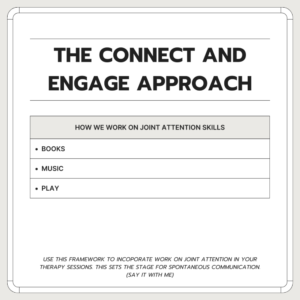
The Connect and Engage Approach
Rose created this 3-pronged approach that guides therapy for students who are not yet speaking. I know the overwhelm when you feel like your students are not making progress despite your best efforts! I hated that feeling, and that motivated me to really dig into the research on joint attention. Creating this research-supported approach has helped me feel more confident, and I know that it will help you feel that way too.
Books
GOAL: Student will engage in a shared interaction with the therapist while engaged in a literacy-based activity for a duration of 3 minutes without prompts, over 3 consecutive sessions.
We know that literacy-based activities are important to embed in therapy, but how do we even get started? I have a couple of rules that I always live by.
Tips:
- Present a book that you think your student may enjoy, or give them a choice of 2 books (choosing increases motivation within sessions).
- Use your own voice when reading the book. (This is essential for social engagement)
- Make it fun. Don’t force engagement. If your student gets up after 30 seconds, just mark that on the data sheet. Keep reading and using an excited tone of voice. They may come back to see what you are doing.
- Use the same book for 3 sessions. This is not from a research article, but just from my lived experience as a therapist). Session 1 allows you to introduce the book. Session 2 allows your student to participate a bit and session 3 will allow your student to participate with an activity that feels more familiar.
Music
GOAL: Student will engage in a shared interaction with the therapist while engaged in a music-based activity for a duration of 3 minutes without prompts, over 2 consecutive sessions.
We know that music-based activities are a great way to focus on connection, communication, and movement! I have a couple of tips when using music in therapy.
Play
GOAL: Student will engage in a shared interaction with the therapist while engaging in a cooperative activity with the therapist for a duration of 3 minutes without prompts, over 3consecutive sessions.
We know that play-based activities are a great way to focus on connection and communication. I have found over the years that many of my students have trouble engaging in traditional cooperative play activities. So below I will share a variety of fun and cooperative activities that can be used in sessions to work on joint attention skills.
Looking One Level Deeper
When a 2-, 3-, or 4-year-old child has limited language, differences in social communication, or difficulty acquiring new skills, it is appropriate to ask what the child can currently do. We hope this developmental framework is useful to behavior analysts, speech-language pathologists, developmental specialists, special instructors, educators, and other professionals working with young children.
We would also like this to be a conversation. If you try some of these approaches in your own practice, if you have found other ways to support joint attention, gesture, representational play, or social learning, or if your clinical experience leads you to think about these skills differently, please share your experience in the comments. Cross-disciplinary discussion is particularly valuable in an area where development and learning are so closely intertwined.
References
- Centers for Disease Control and Prevention. Milestones by 2 Years. Learn the Signs. Act Early. U.S. Department of Health and Human Services. Developmental milestone materials define milestones as skills demonstrated by most children, approximately 75% or more, by the specified age.
- Zubler JM, Wiggins LD, Macias MM, et al. Evidence-informed milestones for developmental surveillance tools. Pediatrics. 2022;149(3):e2021052138. doi:10.1542/peds.2021-052138.
- Centers for Disease Control and Prevention. Milestones in Action: By 2 Years. Learn the Signs. Act Early.
- Griffin, R. (2026). Say it with me: Naturalistic tools to spark speech and social engagement for emergent communicators. John Wiley & Sons.
- Kasari C, Freeman S, Paparella T. Joint attention and symbolic play in young children with autism: a randomized controlled intervention study. Journal of Child Psychology and Psychiatry. 2006;47(6):611-620. doi:10.1111/j.1469-7610.2005.01567.x.
- Kasari C, Paparella T, Freeman S, Jahromi LB. Language outcome in autism: randomized comparison of joint attention and play interventions. Journal of Consulting and Clinical Psychology. 2008;76(1):125-137. doi:10.1037/0022-006X.76.1.125.
- Manwaring SS, Mead DL, Swineford L, Thurm A. Research examining gesture production and gesture profiles in autism spectrum disorder. Gesture use in autistic children demonstrates substantial individual and functional variability.
- Choi B, Shah P, Rowe ML, Nelson CA, Tager-Flusberg H. Research examining gesture use and early language development in children with autism spectrum disorder.
- Centers for Disease Control and Prevention. Milestones by 4 Years. Learn the Signs. Act Early. Pretending to be something else during play is included among developmental surveillance milestones at age 4.
- Adamson LB, Bakeman R, Deckner DF, Romski M. Joint engagement and the emergence of language in children with autism and Down syndrome. Journal of Autism and Developmental Disorders. 2009;39(1):84-96. doi:10.1007/s10803-008-0601-7.
- Kasari C, Gulsrud AC, Wong C, Kwon S, Locke J. Randomized controlled caregiver-mediated joint engagement intervention for toddlers with autism. Journal of Autism and Developmental Disorders. 2010;40(9):1045-1056.
- Kasari C, Gulsrud A, Paparella T, Hellemann G, Berry K. Randomized comparative efficacy study of parent-mediated interventions for toddlers with autism. Journal of Consulting and Clinical Psychology. 2015;83(3):554-563. doi:10.1037/a0039080.
- Shire SY, Chang YC, Shih W, Bracaglia S, Kodjoe M, Kasari C. Hybrid implementation model of community-partnered early intervention for toddlers with autism: a randomized trial. Journal of Child Psychology and Psychiatry. 2017;58(5):612-622.